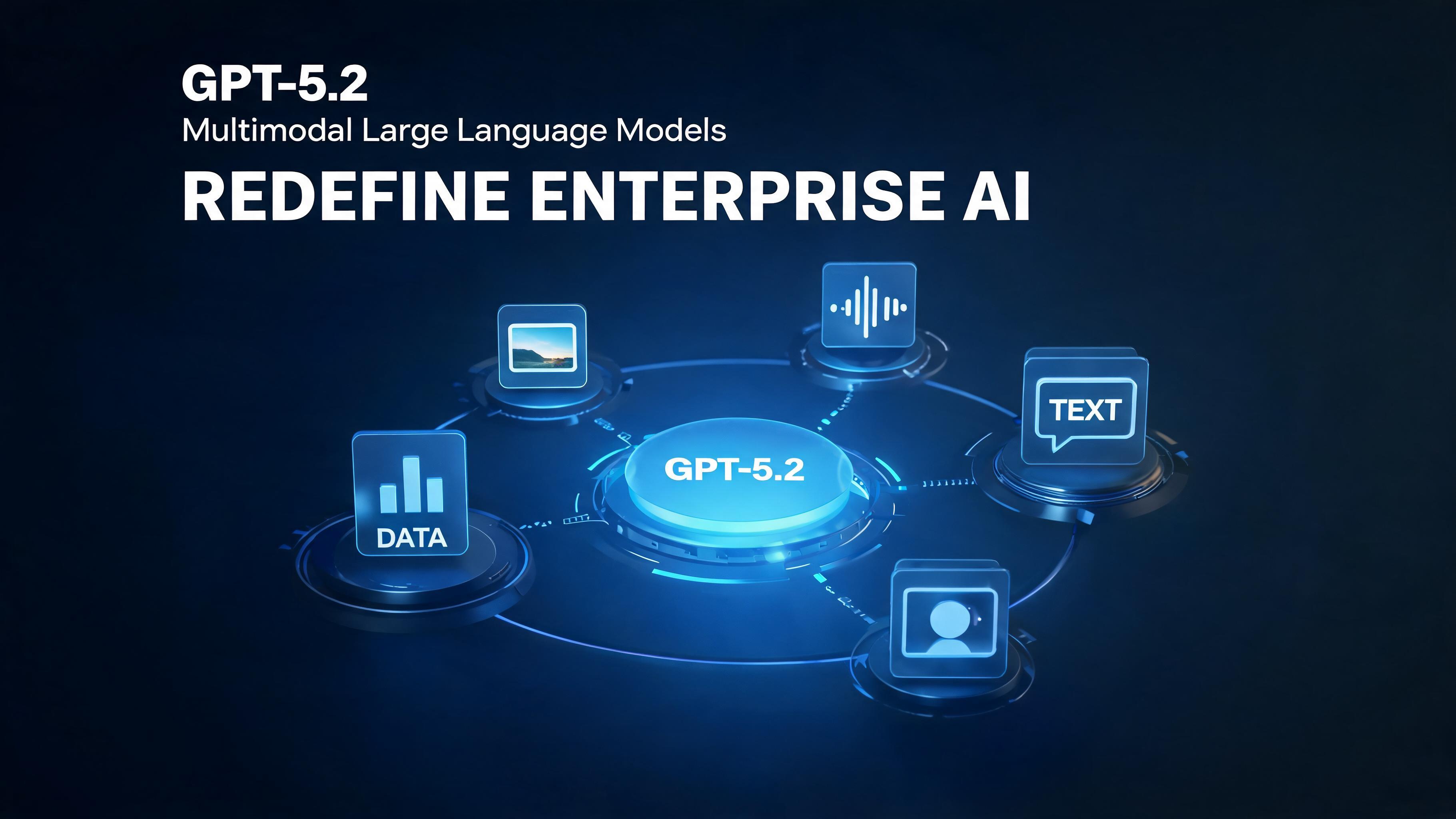
Enterprises are at a crossroads. The release of GPT-5.2 and the rapid maturation of competing multimodal large language models (LLMs) such as Llama 4 and Mistral Large 3 have moved AI from a proof‑of‑concept to a strategic product layer. These models now ingest and generate text, audio, images, and video in a single forward pass, enabling use cases that were previously impossible or required brittle pipelines. This article walks senior engineers through the architectural shifts, implementation patterns, and operational considerations needed to embed true multimodal LLMs into enterprise stacks.
Introduction & Background
The AI landscape in 2026 is defined by three converging trends: (1) scaling of transformer depth to 1‑trillion‑parameter regimes, (2) unified tokenization across modalities, and (3) hardware‑aware model compression that makes real‑time inference feasible on commodity GPUs and specialized ASICs. GPT-5.2 exemplifies these trends with a 1.2 T parameter backbone, a shared multimodal tokenizer, and a dynamic routing engine that activates only the sub‑networks required for a given modality mix. Llama 4 and Mistral Large 3 follow a similar design philosophy, offering open‑source weight checkpoints and plug‑and‑play adapters for domain‑specific fine‑tuning.
Industry analysts note that “multimodal LLMs are the first generation of models that can be treated as a single data‑plane API for enterprise applications” InnoWise. Academic research from Johns Hopkins confirms that unified token embeddings reduce cross‑modal latency by up to 35 % compared with cascade pipelines Johns Hopkins University.
Enterprises must now decide on a model stack that supports text, audio, image, and video while meeting latency, cost, and compliance constraints. The following sections provide a deep dive into the architectural foundations, code‑level patterns, and production‑grade safeguards required for a successful rollout.
Core Architectural Concepts
1. Unified Multimodal Tokenizer
Traditional pipelines use separate encoders (e.g., Whisper for audio, CLIP for images) that feed into a text‑only LLM. GPT‑5.2 replaces this with a single tokenizer that maps raw bytes from any modality into a shared embedding space. The tokenizer emits a stream of modality‑aware tokens, each prefixed with a 4‑bit modality flag. This design enables the transformer to attend across modalities without explicit cross‑attention layers, simplifying the graph and reducing memory overhead.
2. Dynamic Routing & Sparse Activation
A 1.2 T parameter model cannot be fully materialized on a single GPU. GPT‑5.2 employs a Mixture‑of‑Experts (MoE) layer where only a subset of experts (≈10 %) are activated per token. The routing controller uses the modality flag to bias expert selection toward those specialized for audio, vision, or text. This yields near‑linear scaling of throughput while keeping GPU memory under 24 GB.
3. Model Parallelism & Tensor Parallelism
For on‑prem deployments, we recommend a hybrid of pipeline parallelism (stage‑wise sharding) and tensor parallelism (intra‑layer sharding). NVIDIA’s TensorRT‑LLM and the open‑source DeepSpeed‑ZeRO‑3 provide the necessary primitives. The key is to keep the MoE routing state co‑located with the expert weights to avoid cross‑node latency spikes.
4. Service Mesh Integration
Enterprise AI services must coexist with existing micro‑service ecosystems. Deploy the multimodal inference engine behind a gRPC‑based service mesh (e.g., Istio) that handles request routing, retries, and observability. The mesh also enforces per‑tenant quotas, a critical requirement for SaaS platforms like Phew that expose LLM‑generated content to millions of users.
Implementation Blueprint & Code Patterns
Below is a reference implementation that demonstrates how to spin up a GPT‑5.2 inference service using Python, FastAPI, and TensorRT‑LLM. The pattern is equally applicable to Llama 4 and Mistral Large 3 with minor weight‑loading adjustments.
## app.py – FastAPI wrapper for multimodal inference
import os
from fastapi import FastAPI, UploadFile, File
from pydantic import BaseModel
import torch
from tensorrt_llm import LLMEngine

app = FastAPI()

## Load the unified tokenizer (shared across modalities)
from multimodal_tokenizer import UnifiedTokenizer
tokenizer = UnifiedTokenizer(model_path="/models/gpt5.2/tokenizer")

## Initialize TensorRT‑LLM engine with MoE routing
engine = LLMEngine(
    model_dir="/models/gpt5.2",
    max_batch_size=32,
    max_input_len=2048,
    max_output_len=512,
    enable_moe=True,
    device="cuda",
)

class InferenceRequest(BaseModel):
    prompt: str
    modality: str  # "text", "image", "audio", "video"
    # Optional base64‑encoded payload for non‑text modalities
    payload: str | None = None

@app.post("/v1/infer")
async def infer(req: InferenceRequest):
    # Tokenize based on modality flag
    tokens = tokenizer.encode(req.prompt, modality=req.modality, payload=req.payload)
    # Run inference – engine handles dynamic routing internally
    output_ids = engine.generate(tokens)
    # Decode back to multimodal representation
    response = tokenizer.decode(output_ids)
    return {"output": response}
Key Patterns Explained
- Unified Tokenizer Wrapper – The
UnifiedTokenizerabstracts modality handling. Internally it converts images to a 2‑D patch embedding, audio to mel‑spectrogram tokens, and video to spatio‑temporal token streams before concatenation. - Dynamic MoE Activation –
enable_moe=Truetells TensorRT‑LLM to load the routing tables at runtime. This eliminates the need for custom routing code. - Batch‑Level Modality Mixing – The service accepts mixed‑modality batches, allowing a single GPU to process a batch of 16 text prompts and 16 image captions simultaneously, maximizing utilization.
For enterprises that require on‑prem compliance, the same code can be containerized with Docker and orchestrated via Kubernetes. A Helm chart that sets resources.limits to gpu: 4 and configures nodeSelector for GPU‑enabled nodes ensures predictable scaling.
Production Edge Cases & Performance Tuning
1. Latency Budgets by Modality
- Text‑only: sub‑100 ms 99th‑percentile latency is achievable with a single GPU.
- Image: tokenization adds ~30 ms; inference remains <200 ms.
- Audio: mel‑spectrogram extraction can dominate; pre‑compute embeddings for streaming use cases.
- Video: the biggest challenge; recommend frame‑sampling (e.g., 1 fps) and caching intermediate token streams.
2. Quantization Strategies
Post‑training quantization to INT8 reduces memory footprint by ~4× with <2 % BLEU degradation for text and <3 % PSNR loss for images. For audio, a mixed‑precision approach (FP16 for spectrograms, INT8 for transformer layers) balances quality and speed.
3. Autoscaling Policies
Leverage Kubernetes Horizontal Pod Autoscaler (HPA) with custom metrics from TensorRT‑LLM (e.g., gpu_utilization). Combine with a queueing layer (Redis Streams) to smooth burst traffic from high‑visibility products like NoCode PDF where users may upload dozens of PDFs per second.
4. Observability & Tracing
Instrument the FastAPI service with OpenTelemetry. Capture modality‑specific spans (tokenize_image, generate_audio) and export to a Prometheus‑Grafana stack. Alert on latency spikes that exceed 2× the baseline for any modality.
Security & Reliability Considerations
Data Privacy
Multimodal inputs often contain personally identifiable information (PII). Apply on‑the‑fly redaction for text and blur faces in images before tokenization. Store no raw payloads; only retain hashed request IDs for audit trails.
Model Guardrails
Deploy a secondary “policy LLM” that evaluates generated content for compliance (e.g., GDPR, HIPAA). The policy model runs in a lightweight container and can veto or rewrite outputs before they leave the service mesh.
Fault Isolation
Use Istio’s circuit‑breaker patterns to isolate a failing MoE expert. If an expert crashes, the router automatically falls back to a default expert, preserving service continuity while logging the incident for post‑mortem analysis.
Disaster Recovery
Maintain a warm standby cluster in a different region (e.g., US‑East vs EU‑West). Replicate model weights via rsync and keep the tokenizer version‑locked. In a failover, DNS routing can switch traffic within seconds, ensuring SLA compliance for mission‑critical applications like Yistrict.
Summary & Next Steps
GPT‑5.2, Llama 4, and Mistral Large 3 have crystallized the multimodal LLM paradigm, offering a single API surface for text, audio, image, and video. To capitalize on this shift, enterprises should:
- Adopt a unified tokenizer to simplify data pipelines.
- Leverage MoE‑enabled inference engines (TensorRT‑LLM, DeepSpeed) for cost‑effective scaling.
- Embed the service behind a robust mesh that enforces quotas, retries, and observability.
- Implement modality‑aware performance tuning (quantization, autoscaling, caching).
- Harden security with PII redaction, policy LLMs, and fault isolation.
By following the blueprint above, engineering teams can transition from experimental prototypes to production‑grade multimodal AI services that become a competitive differentiator across domains—from community engagement platforms like Yistrict to document automation tools like NoCode PDF.
Ready to future‑proof your AI stack? Reach out to our specialists for a tailored architecture review at /contact.
Sources
Building something similar?
We engineer mission-critical web applications, AI integrations, and cloud platforms for ambitious teams.